Small drones and the protection of the UK defence estate
An open-source assessment of whether the United Kingdom can protect its defence estate against commercially derived quadcopters and first-person-view drones.
Research & analysis
Independent research and analysis on emerging security risks, critical infrastructure and organisational decision-making.
Latest writing
Short analysis on security, infrastructure and the decisions organisations make when the evidence is incomplete.
An open-source assessment of whether the United Kingdom can protect its defence estate against commercially derived quadcopters and first-person-view drones.
Active defences can be defeated or designed around. A roof has no false-positive rate, needs no operator and protects the target even when nobody detects the drone.
Counter-drone investment repeatedly follows the incident that justified it. The pattern says less about competence than it does about how organisations allocate money against unfamiliar risks.
Gatwick lost around thirty hours and roughly £50 million to sightings whose physical cause was never established. The operational lesson is about ambiguity, not simply airport security.
The point of employment needs to be near the target, not near the sponsor. Remoteness can work in the opposite direction to conventional protection because fewer people are present to notice.
Featured research
Persistent aerial surveillance and the ability to place a payload precisely on a target can now be bought, assembled and flown by individuals with a few thousand dollars and an internet connection.
View all six findings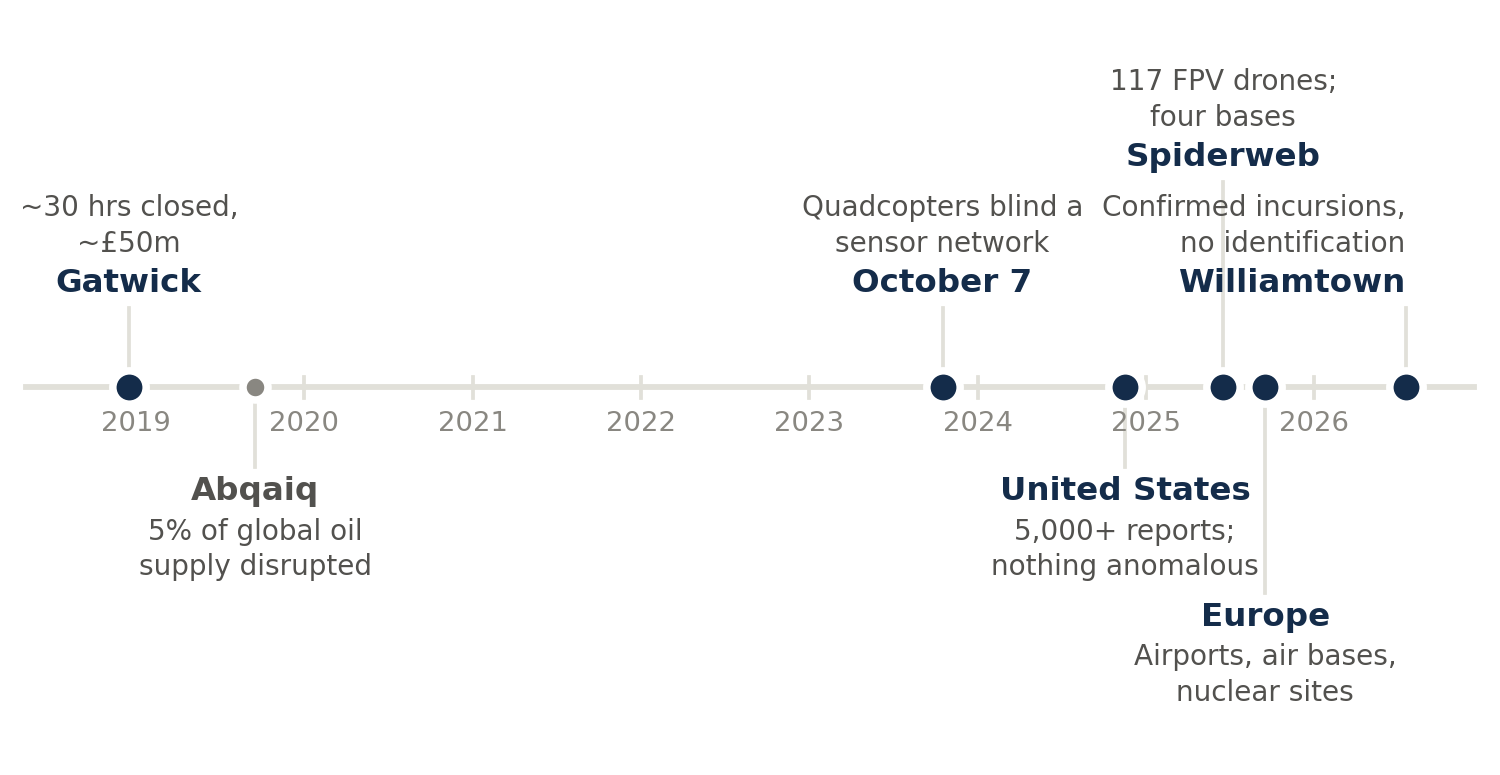
All research statements on this site are drawn from Distance Is Not a Defence — Australia’s Vulnerability to Small Drones, Version 8 draft, September 2026.
About
Shelby Glaskin is the author of Distance Is Not a Defence, a strategic assessment of Australia’s vulnerability to small drones.
The paper is based entirely on open-source research and is written for industry leaders, critical infrastructure operators and government stakeholders.
Discuss the research